

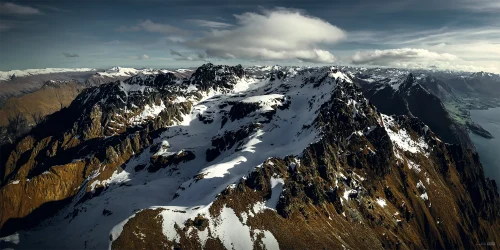
A view like this could only be the South Island. Sharp ridgelines, snow-covered faces and the mightiest of peaks appearing above the cloud. Llawrenny Peaks lies south of Milford Sound.

Deep within Fiordland National Park, the Cleddau River cascades its way through dense forest before finally arriving at the jewel that is Piopiotahi/Milford Sound. Left mostly untouched thanks to its UNESCO World Heritage status, Fiordland offers many spectacular and powerful sights such as this.

Those who take on the Abel Tasman Coastal Walk are rewarded with the incredible sight of Awaroa Beach along the way. A remote and picturesque bay, Awaroa Bay reveals its endless golden sands at low tide.

Motukorea/Browns Island remains as one of New Zealand's most intact volcanos and a reminder of the country's volcanic past. From high above, the island shows off the remnants of its volcanic crater now hidden beneath grassy fields.
Cecil Peak is an icon on the Queenstown landscape. This perspective on Cecil Peak offers a glimpse high above to see what lies on the other side of this familiar Lake Whakatipu peak. From here, the endless layers of mountains rolling into Fiordland and Mt Aspiring national parks are revealed.

Ominous and enthralling clouds roll over Mt Aspiring National Park at the head of the Dart Valley.

At 3,724 metres tall, Aoraki/Mt Cook is New Zealand's highest peak. Very few will see the mountain from this angle. Its distinctive flat top was shaped by a rock avalanche that caused the collapse of the top of the mountain in 1991.

Ice and rock and a hundred variations of white and grey. Here, Mt Aspiring shows the sheer rock wall of its south face leading up to the 3,033-metre high summit.

As sunshine streams in, the dark, deep-green forest is illuminated. For a moment, the depth of this lush and vibrant Fiordland National Park forest are revealed.

Sunset over Te Henga/Bethells Beach along the black sandy coastline of the North Island's west coast. The evening brings a quiet moment in a coastline well-known for its wild and raucous surf.

The ocean finds a way through the layered rock formations at Punakaiki. Relentless wave action and limestone rock combine to create a unique and intriguing location on the west coast of the South Island.

An aerial expedition above Aoraki/Mt Cook National Park captures the incredible formation that is the Tasman Glacier. Deep in the Southern Alps, Tasman Glacier is found alongside New Zealand's highest mountains, Aoraki/Mt Cook and Mt Tasman.

The pointed summit of Mt Alfred casts the eye towards Lake Whakatipu and its immense u-shaped glacial valley. The picturesque township of Glenorchy and the braided Dart River valley lie close to the base of Mt Alfred.

Old-growth beech forest just off Arthurs Pass. Here, a carpet of moss blankets the forest floor and rotting trunks, providing spectacular variations of green.

When patience is rewarded. A perfect moment of stillness on Lake Lochnagar in Skippers Canyon. Very few get to visit Lochnagar along the old Skippers Road, even fewer will see it on a day like this.

Beginning under the watchful gaze of Rahotu/Mitre Peak, Milford Sound is a steep and narrow glacially carved valley that attracts visitors from around the globe. It is immense in scale and natural beauty.

From the Coronet Peak road, the Whakatipu Basin stretches out in every direction, bordered by steep mountain ranges and lakes. The Remarkables to the south and the Crown Range to the east and mighty Lake Whakatipu to the west.

From below, it is hard to imagine the amount of snow this mighty peak holds. Stephan's lens captures the immense snow load atop Mt Aspiring. While much of this snow stays all year round, a lot of melts during the warmer months to become spectacular clear and pure water of Mt Aspiring National Park and its many rivers.
